un-like
un-like
This project was created in collaboration with Un-like, a studio focused on designing and producing bespoke lighting solutions.
I was asked to create a series of six illustrations for their website that explain each step of their workflow — from the first conversation to the final installation.
Instead of using abstract diagrams or overly stylised visuals, the aim was to show the process through real, recognisable moments: people sitting together, sketching, discussing, making decisions, and building objects. The focus is on how the work actually happens.
un-like — process illustration series
Approach.
The illustrations are based on observation and everyday interactions. Each scene captures a specific moment in the process, with attention to body language, gestures, and the small details that make collaboration feel real.
The visual style remains consistent throughout the series:
natural proportions and grounded compositions
soft textures and bright colour palettes
a balance between structure and hand-drawn imperfection
Rather than exaggerating or simplifying the process, I aimed to present it as it is — calm, focused, and human.
The progression across the series is subtle:
early stages feel more open and conversational, while later stages become more structured, precise, and material.
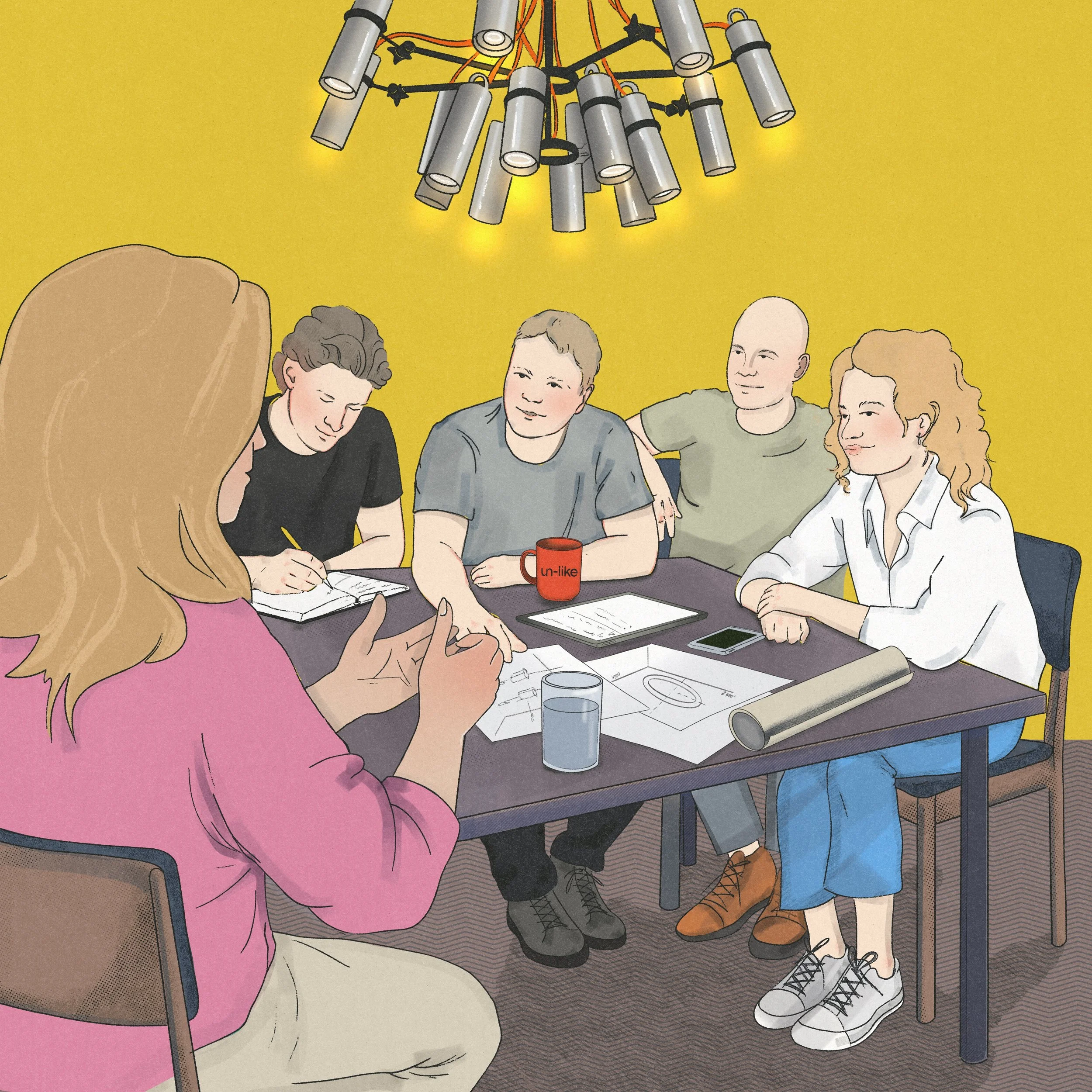
The studio's process opens with full absorption of the brief — studying the space, its context, budget, and constraints. The illustration captures a collaborative listening moment: the four-person team in conversation with an architect or client, the mood open and attentive rather than presentational.
Key visual cues
{Team in conversation} {External collaborators} {Listening posture} {Shared table or space}
✦ The scene prioritises openness over formality — less presentation, more genuine exchange.
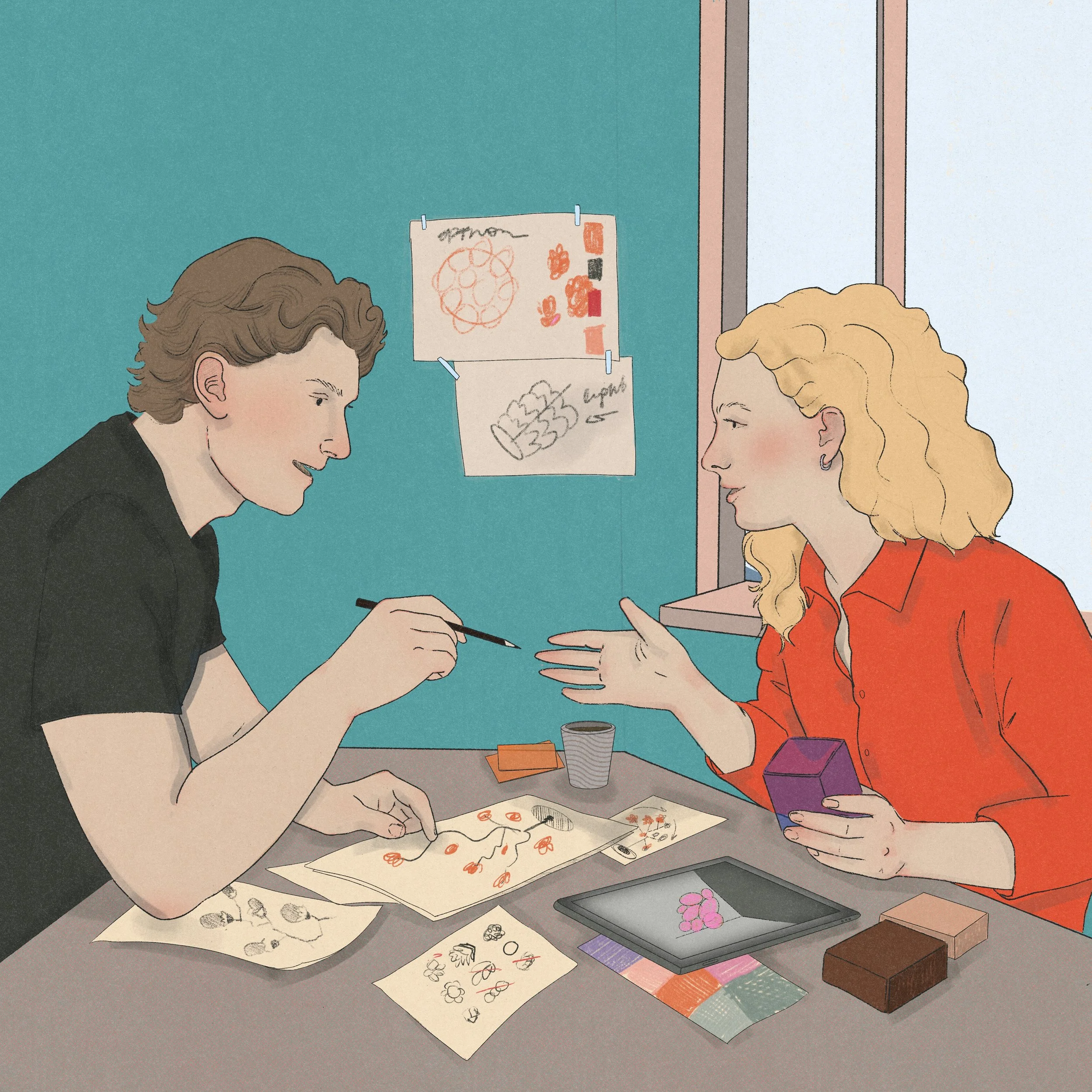
Two designers — actively sketching, exchanging ideas — surrounded by overlapping drawings, half-finished forms, and alternative shapes. This phase should feel energetic and slightly chaotic: ideas in motion, nothing fixed yet. Papers, sketchbooks, tablets, and wall-pinned notes create a layered, generative atmosphere.
Key visual cues
{Hand sketches} {Multiple form variations} {Designer dialogue} {Light and material experiments}
✦ The visual language is deliberately loose here — energetic and exploratory, reflecting the openness of this phase.
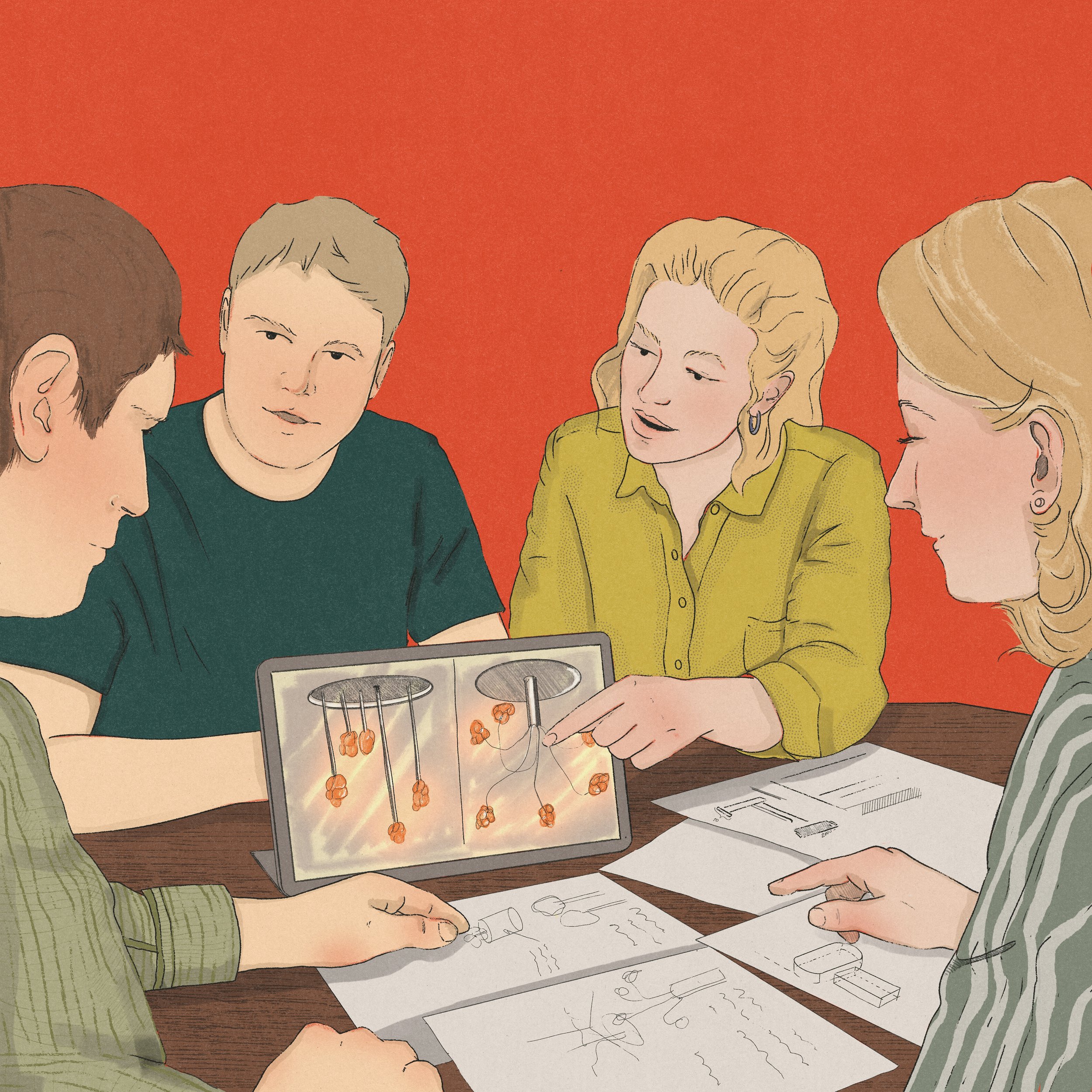
A focused presentation moment: one or two clear concepts shown to the client around a table or screen. Fewer ideas than before, but more defined. The client is visibly engaged — pointing, reacting, responding. Sketches and simple 3D renders are visible in the scene.
Key visual cues
{1–2 defined concepts} {Sketches} {Client engagement} {Decision-making dynamic}
✦ Clarity and focus are the visual priorities — this is where exploration narrows to a single shared direction.
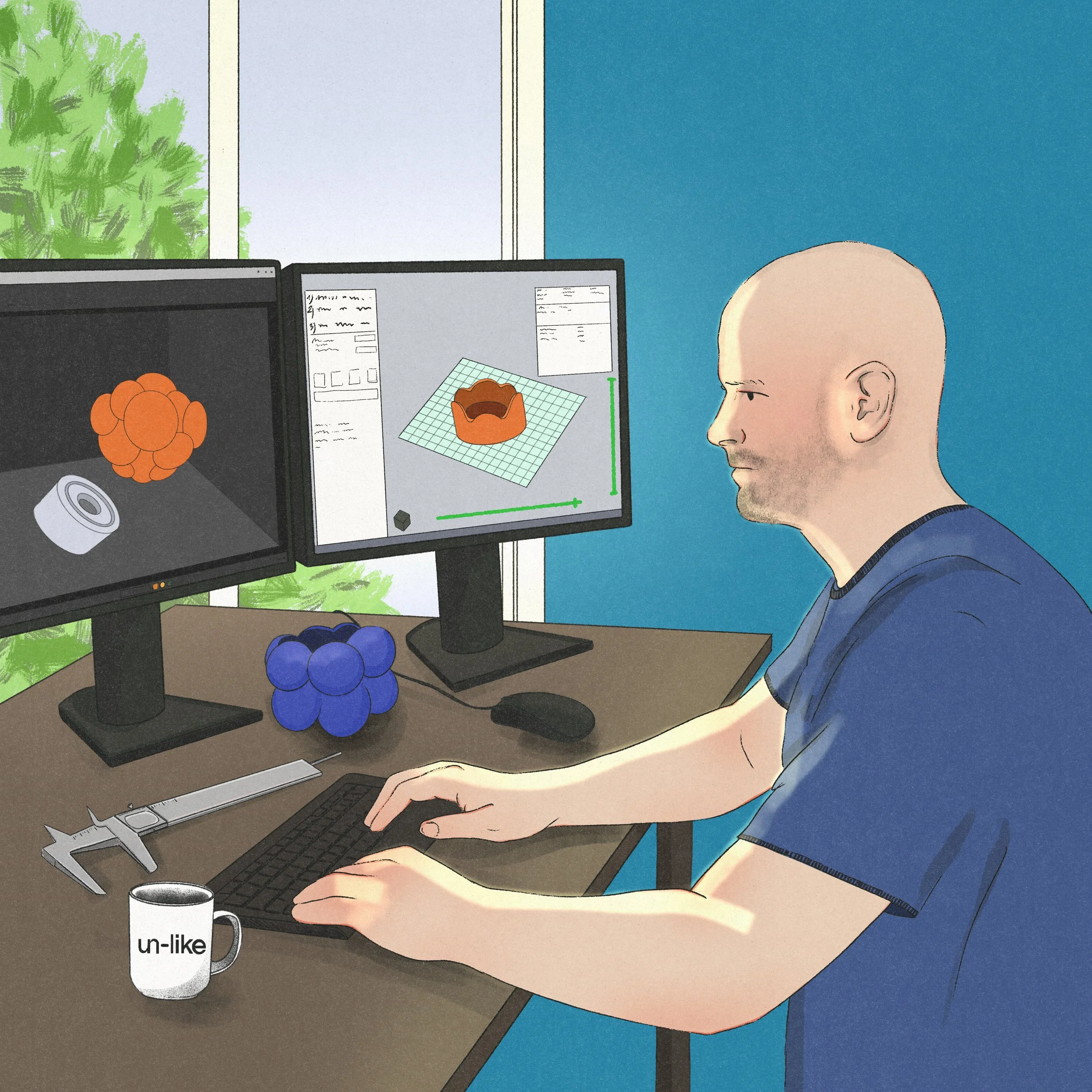
A designer working at a computer with clear technical focus. The screen shows CAD-style lines, measurements, and sections. Around the figure, the same object appears as exploded views, component layers, and dimensions — the same idea, now precisely resolved. The atmosphere is calm and methodical.
Key visual cues
{Technical drawings} {CAD-style visuals} {Measurements and structure} {Engineering mindset}
✦ The visual mood shifts here — quieter, more focused, with precision replacing the earlier looseness.
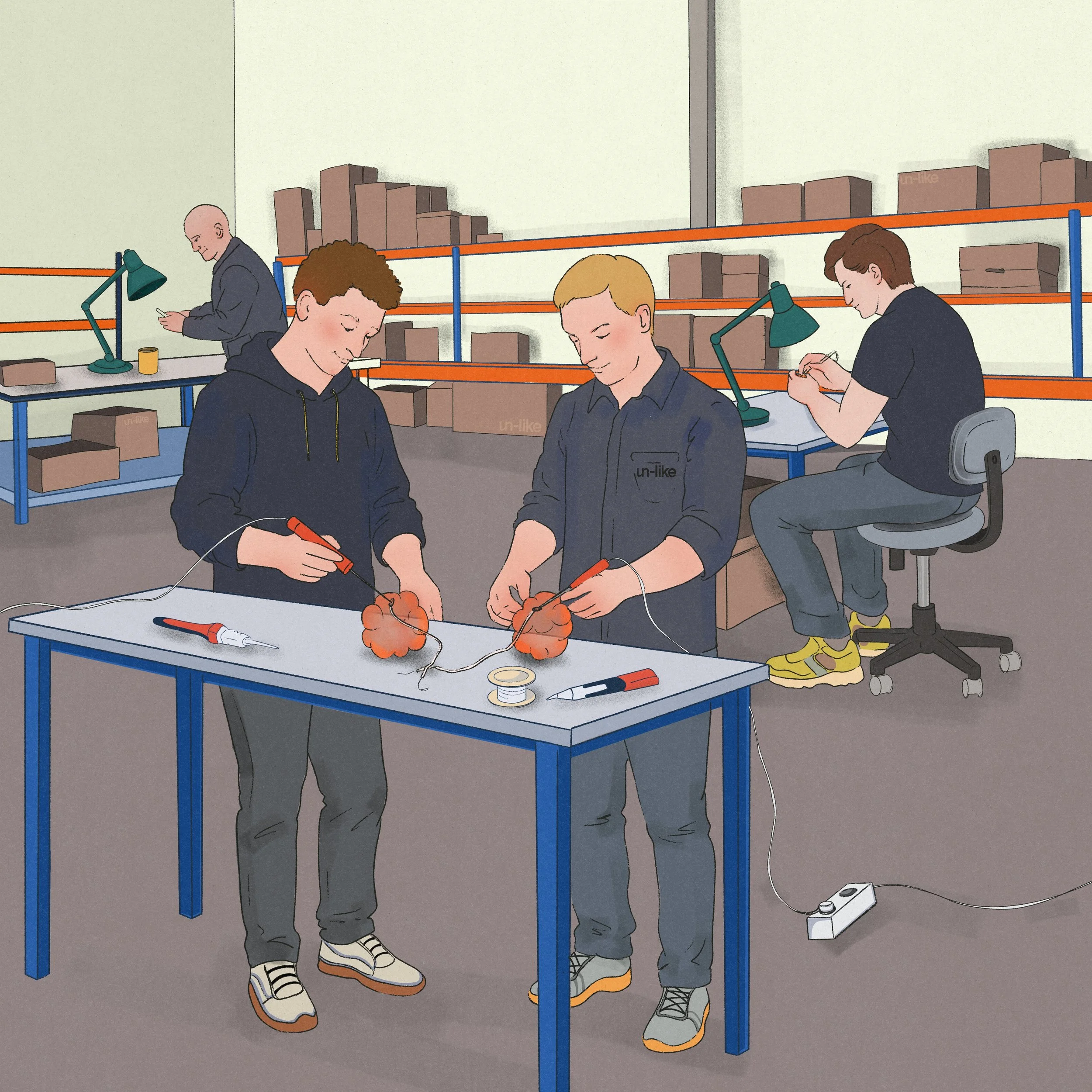
A workshop or production scene: hands working, tools, materials, and partially assembled luminaires. Not a factory — a making environment defined by craftsmanship and care. The illustration is slightly abstracted, keeping focus on the quality of attention rather than scale of production.
Key visual cues
{Assembly process} {Materials and tools} {In-progress objects} {Hands-on production}
✦ The emphasis is on craft — controlled, careful, and human in scale.
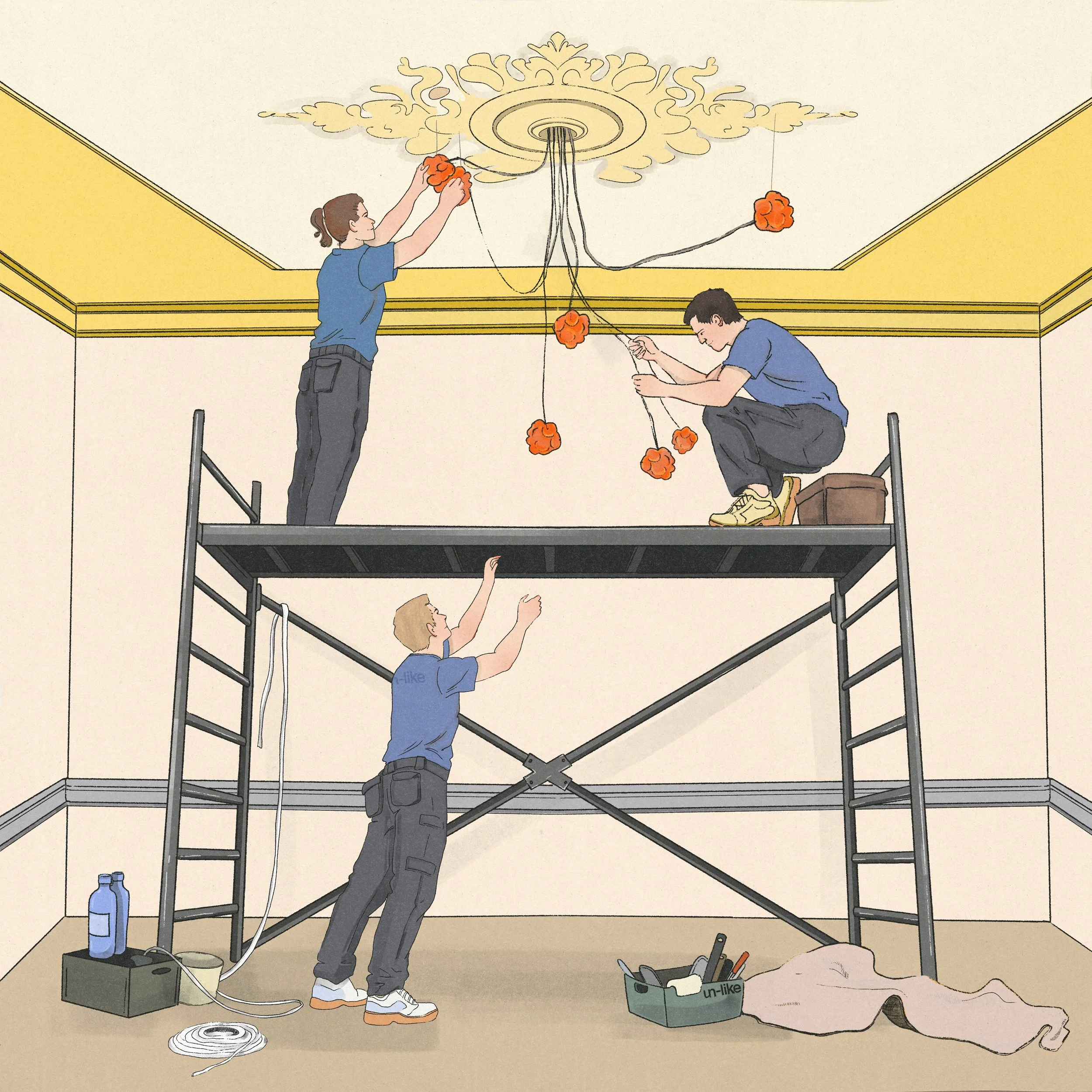
The finished lighting is being installed or just finalised on site. A technician adjusts or mounts the piece — the luminaire already lit or about to be. The architectural setting is visible but simplified, allowing the light to remain the focus. Calm and resolved: the object becomes part of the space.
Key visual cues
{Installer present} {Luminaire in place} {Architectural context}
✦ This is the closing image of the series — everything comes together, the journey from idea to real space complete